


The first time I arrived in the Lembeh Strait, returning from the Bunaken Marine Park, I thought I had the wrong place.
I came out of a heaven fell to the earth made of white sandy islands, crystal clear sea and palm trees, and now, in front of me, stretched a cargo port seamlessly, and I wondered for a moment what the hell I was doing there…not to say that the more experienced underwater photographers had spoken about it!
The idea I had created was typical of the traveler in search of a new haven: loneliness, palm trees, clear water, white beaches, silence and all the corollary of possible images surrounding a naturalistic adventure dream.
I confess that discouragement seized me for a moment. Fortunately, I was wrong…
It happens, in fact, that in this part of the world there are still places that, beside those industrialized and densely populated, can offer just around the corner our eyes can see, unexpected paradises sunken amongst tropical forests, mangroves, fishing villages and a sea of rare wealth, all surrounded by the characteristic and inevitable black volcanic sand.

This is the Lembeh Strait: a contrasting vision of the far north of Indonesia, in the long Sulawesi peninsula; 16 km split between an industrial harbor and the equatorial forest, towered by the extinct Klabat volcano at whose foot the pace of life is still naturally beaten by the sun’s rising and setting.
Small and large boats cross the strait constantly at any time of day or night.
These boats carry everything the residents, mostly fishermen or workers at the large commercial and industrial port, need.
For centuries, because of its geographical location, it was first a natural refuge for many ships from around the world, and now is an essential destination for the exchange of goods by sea.
The port is located in Bitung, a typical Asian seaside city, offering all kinds of traffic, smells, curious looks, sounds, realities, religions and contradictions.
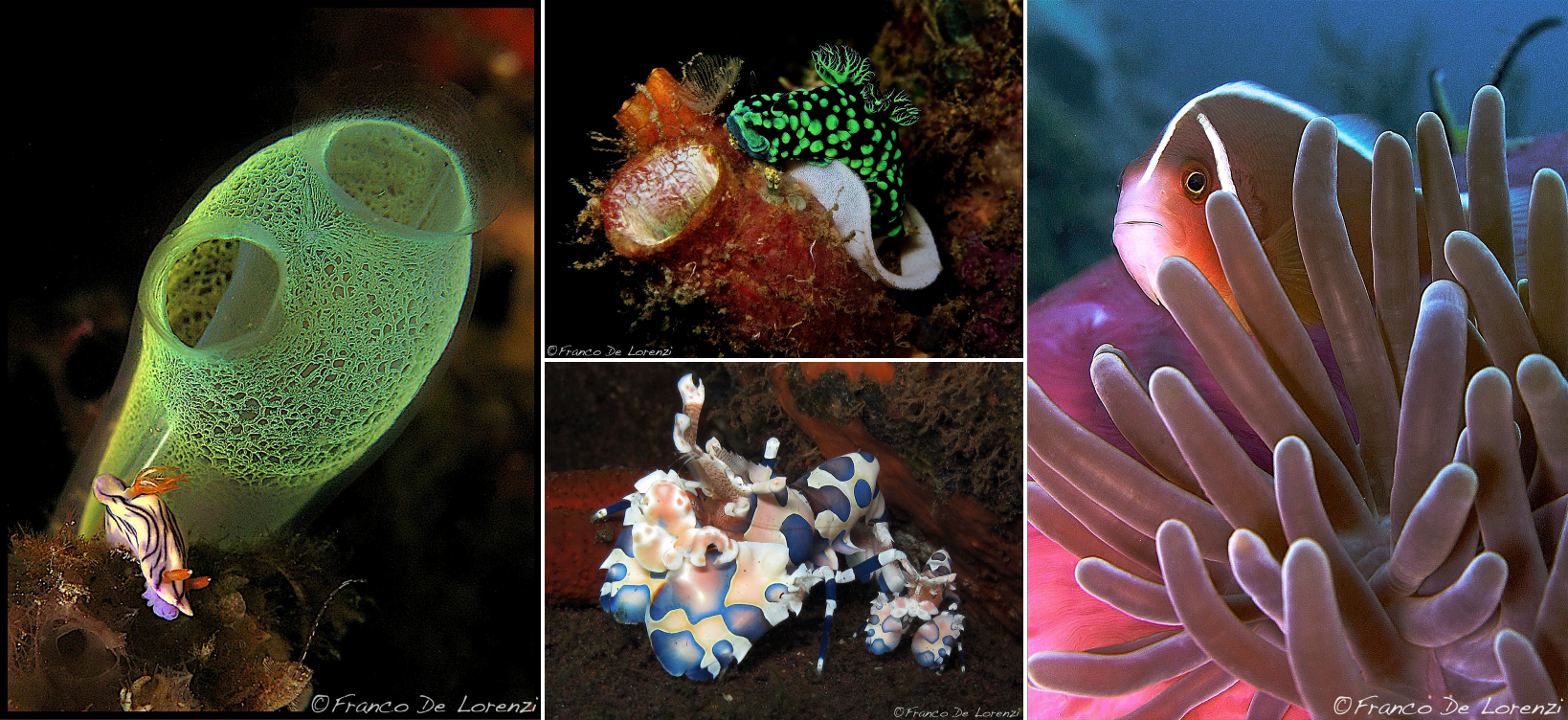
And everything goes through the waters of these two shores of 16km per side, renowned around the globe for their incredible variety of marine animals, which became a mandatory destination for biologists, underwater photographers and video reporters. It is believed that the strait is one of the areas on the planet with the highest biodiversity concentration.
The crossing of the ocean currents coming from the Moluccas Sea and the Celebes Sea generates a planktonic concentration ideal for maintaining and developing of marine life conditions among the most intense and diverse on earth.

My opinion, unsupported by research or studies and therefore questionable, but not far from reality, is that this rich biodiversity depends precisely from the industrial port and the traffic of fishing boats from the nearby Philippine and Malaysian waters.
Ships from all over the world, with their keels, become a natural means of transportation for eggs or alien organisms in this aerial. In addition, these same ships, during the cleaning of their holds, sometimes discharge in the Strait waters coming from different and distant seas, containing marine life in the larval stage.
Nature then will do the rest: if environmental conditions are favorable to new biological materials, the eggs or spores will give way to a new water population and the more these conditions are favorable, the quicker the process. Otherwise, it will happen exactly what usually happens in nature when there are no favorable conditions: the extinction.
The attempt to give the idea of the Lembeh Strait through a few shots is quite restrictive.
Encyclopedias are not enough to pay tribute to this corner of the world; therefore, my goal is just to share the small and great astonishments these waters gave me.
Going perhaps against the current, I would like to show you this Ocean corner through the lenses of a compact camera, demonstrating that anyone can get good results with poor equipment, affordable for everyone.
Where to dive?
The Lembeh Strait has only the spoilt for choice and the best-known sites like Nudifall, TK1 or 2, Airprang, Pulau Maka Widi, Magic Rock and many others will certainly be among the destinations offered by your resort, wrecks included.
However, I would recommend (if you love the spirit of research) to observe the coast and venture out looking for less obvious and maybe never visited places: the result could give you enormous surprises.
Talk with your guides and tell them what you are looking for, and their preparation will surprise you. Find out the best time in the year to enjoy the utmost visibility, but do not avoid no season, since every month is right for seasonal or new encounters.
WORDS and PICTURES by Franco De Lorenzi


